

Biodiversity Risk in Supply Chains: Why Nature Has Become the Next Boardroom Issue

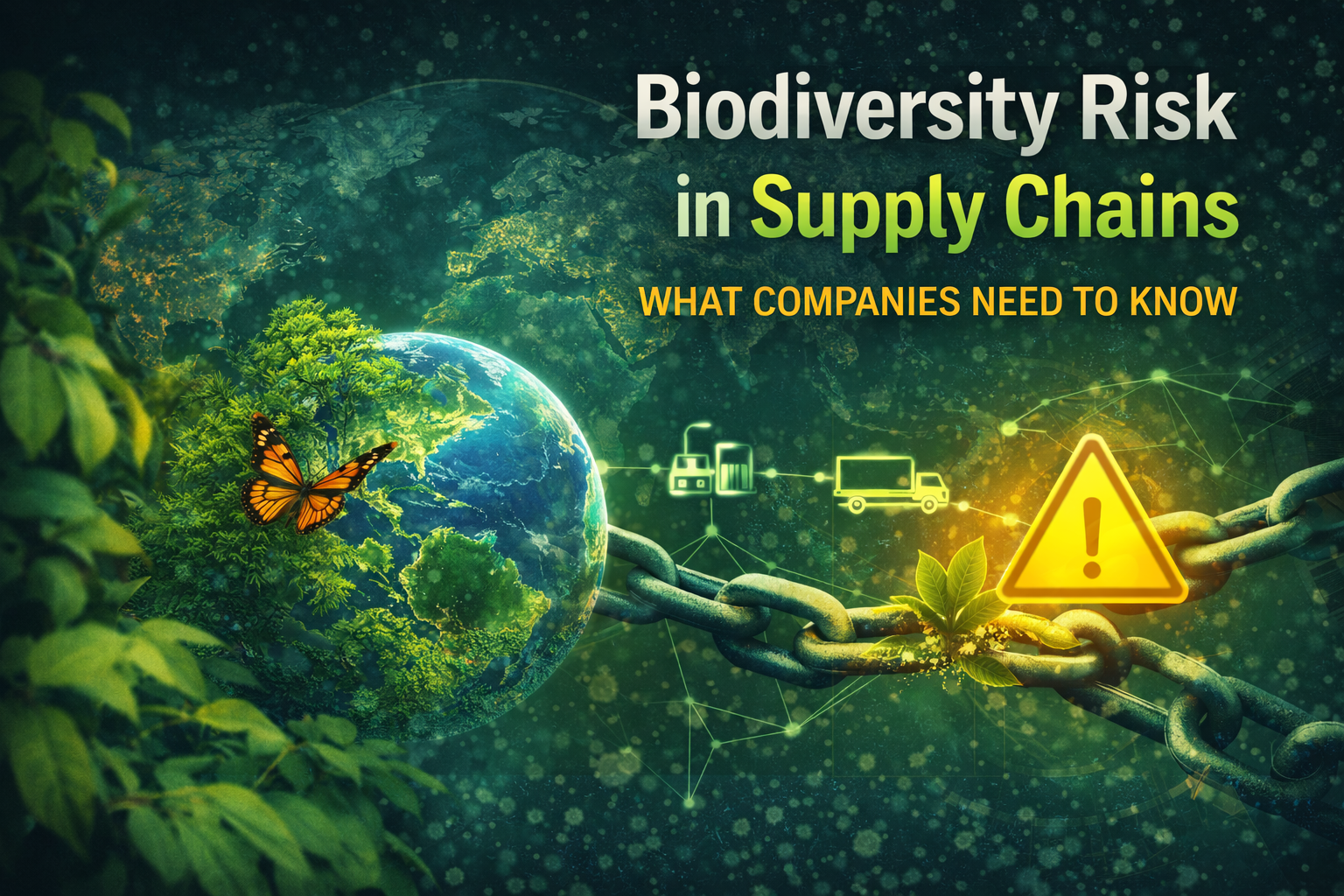
Biodiversity Risk in Supply Chains: Why Nature Has Become the Next Boardroom Issue
Introduction: Why biodiversity risk in supply chains is now a strategic issue

For years, when companies spoke about sustainability, the conversation almost always returned to carbon. Carbon emissions. Carbon offsets. Net-zero pathways. Climate disclosures. Emissions inventories. Science-based targets. Entire corporate architectures were built around measuring, reporting, and managing carbon performance.
That focus was justified. Climate change was visible, quantifiable, and increasingly tied to investor expectations, regulation, and long-term enterprise value.
But over the last few years, another risk has been quietly moving from the margins into the centre of strategic business decision-making.
That risk is biodiversity.
And not biodiversity in the old, decorative sense of the word — not as a CSR topic, a philanthropic programme, or a paragraph in the sustainability report. Biodiversity is now emerging as a hard business issue because supply chains do not operate in isolation from nature. They are built on top of living systems. Soil fertility, freshwater availability, pollination, healthy forests, flood regulation, coastal resilience, and ecosystem stability are not abstract environmental concepts. They are production conditions.
Once those systems begin to degrade, supply chains do not merely become less sustainable. They become less reliable, more expensive, more exposed to disruption, and in some cases, less compliant with market access requirements.
That is why biodiversity risk has become one of the most important strategic blind spots in modern supply chain management.
The old model of supply chain visibility is no longer enough
Most companies still define supply chain visibility in conventional terms. They know their suppliers. They know their sourcing regions at a broad level. They track logistics routes, procurement costs, quality metrics, and delivery timelines. Some are even relatively mature in supplier ESG screening, particularly for labour, health and safety, and carbon data.
But biodiversity risk does not fit neatly into this traditional model.
A company may know the name of a supplier, the commodity it purchases, and the volume it sources. What it often does not know is whether that supplier operates in or near a protected habitat, a biodiversity hotspot, a deforestation frontier, or a water-stressed basin. It may not know whether the crop system depends on pollination services under pressure, whether the landscape has suffered cumulative ecosystem degradation, or whether regulatory risk is building because of land conversion in the area.
That is the real shift underway.
Carbon can often be aggregated into a global metric. Biodiversity cannot. Carbon is measured in tonnes. Biodiversity is measured through context. It is local, place-based, ecosystem-dependent, and highly sensitive to how and where production occurs.
This means that two suppliers of the same commodity can present completely different biodiversity risks, even if they appear identical in a conventional sourcing database.
And that is precisely why so many companies feel comfortable with their sustainability reporting, yet remain unprepared for nature-related scrutiny.
Why biodiversity risk has become urgent between 2023 and 2026
What has changed is not only the ecological reality, although that alone is profound. The scientific evidence has been clear for some time that biodiversity loss is accelerating across terrestrial, freshwater, and marine ecosystems. What has changed more dramatically between 2023 and 2026 is the expectation placed on companies to understand, assess, and disclose their relationship with nature.
Three developments have made this a board-level issue.
The first is the convergence of disclosure frameworks around nature. The Taskforce on Nature-related Financial Disclosures, or TNFD, has provided companies with a structured way of thinking about nature-related dependencies, impacts, risks, and opportunities. Its LEAP approach — Locate, Evaluate, Assess, Prepare — is important not because it introduces another reporting acronym, but because it gives organisations a practical pathway for converting nature risk into management action.
The second is regulation. Europe has been especially influential here. ESRS E4 under the Corporate Sustainability Reporting Directive has pushed biodiversity and ecosystems into mandatory sustainability reporting for in-scope organisations. The EU Deforestation Regulation has changed the tone of the discussion entirely by requiring geolocation-based due diligence for certain commodities and derived products. This is not a vague aspiration. It is highly specific. It forces companies to know where relevant products come from and whether they are linked to deforestation after the regulatory cut-off date. The Corporate Sustainability Due Diligence Directive has further reinforced the expectation that companies identify and address environmental impacts across their chain of activities.
The third is the maturing of methods and tools. A few years ago, many biodiversity discussions stalled because companies lacked practical ways to screen and monitor exposure. That is no longer the case. Today there are credible datasets, geospatial tools, and monitoring platforms that allow companies to begin mapping risk in a way that is materially useful. Protected areas data, Key Biodiversity Area layers, water risk mapping, species-risk datasets, deforestation alerts, satellite monitoring, and dependency assessment tools now make it possible to move from broad commitments to targeted action.
In other words, the excuse that biodiversity is “too difficult to operationalise” is becoming less defensible.
Why biodiversity is harder to measure than carbon
That said, biodiversity is still significantly harder to manage than carbon, and executives need to understand why.
Carbon is comparatively elegant. It is imperfect, of course, but it is relatively standardised. You can consolidate emissions across sites. You can compare year-on-year performance. You can model scenarios around reductions.
Biodiversity is messier because it includes different dimensions of nature: habitats, species, ecosystem functions, land-use pressures, freshwater systems, and ecological condition. A company may be highly dependent on one ecosystem service and highly damaging to another. A sourcing basin may be ecologically fragile even if the supplier itself appears operationally stable. A business may have relatively low direct biodiversity impact in its own operations, yet substantial nature exposure deep in the upstream value chain.
This is why biodiversity measurement often feels frustrating inside companies. Different tools produce different outputs because they measure different things. Some measure pressure. Others measure sensitivity. Others model ecological condition or species threat. Some are screening tools. Others support more detailed analysis. There is no single magic number that captures biodiversity risk in the way many people wish it would.
That is not a flaw in the field. It is a reflection of ecological reality.
The challenge for companies, therefore, is not to wait for a perfect metric. It is to build a decision-useful system using the best available layers of information.
The illusion of readiness in corporate sustainability programmes
One of the patterns I have seen repeatedly in practice is what I would call the illusion of readiness.
Many organisations feel that they are progressing because they have published sustainability reports, adopted supplier codes of conduct, and improved their climate disclosures. But when you ask a few simple operational questions, the confidence often begins to crack.
Which of our priority suppliers operate in biodiversity-sensitive areas?
Which of our high-volume commodities are most associated with land-use change?
Where do we face overlapping exposure to water stress, habitat sensitivity, and commodity dependence?
How much of our upstream sourcing can actually be traced to location?
What do we do if a sourcing area is identified as high risk?
These are not theoretical questions. They are management questions. And in many companies, the answers are incomplete, fragmented, or absent.
That is why biodiversity risk management cannot be left inside the reporting function alone. It must connect with procurement, supplier engagement, legal, compliance, enterprise risk, and data architecture. Nature risk is shaped upstream by sourcing choices, contract structures, traceability expectations, escalation processes, and decisions about where and how to buy.
If those mechanisms remain disconnected from sustainability intelligence, the company may disclose well while still managing badly.
What leading companies are beginning to do on biodiversity and nature risk
Some companies have already begun to shift from commitments to operating mechanisms.
In cocoa, several major multinationals have moved toward farm mapping, satellite monitoring, and deforestation-risk screening in producing landscapes. These efforts are not perfect, but they demonstrate what practical biodiversity and nature-risk management starts to look like when traceability becomes operational rather than rhetorical.
In palm oil and rubber, businesses have increasingly recognised that responsible sourcing cannot rely on policy statements alone. It requires supplier traceability, land-use monitoring, clearer procurement rules, and engagement beyond tier one.
In timber and forest-related materials, companies are combining certification, supplier due diligence, and location-specific monitoring to reduce the risk of illegal sourcing, forest degradation, and ecosystem conversion.
Financial institutions are also beginning to test nature-related risk frameworks using portfolio and sector analysis. This matters because it signals that biodiversity is no longer viewed only as an issue for commodity producers or consumer brands. It is being translated into financial-risk language.
These examples matter because they show that biodiversity risk can be managed — but only when companies move from principles to systems.
How companies can start measuring biodiversity risk in supply chains
For companies that are serious about getting ahead of this issue, the path forward should be pragmatic rather than performative.
The first step is to define scope. Not every commodity, supplier, or geography can be mapped in full detail immediately. Start with the parts of the supply chain that are most nature-dependent, most exposed to land-use change, or most likely to trigger regulatory or customer scrutiny.
The second step is geolocation. This is the foundation. Without knowing where sourcing happens, biodiversity assessment remains superficial. Even if exact farm polygons are not immediately available, companies can begin with region-level proxies and improve from there.
The third step is hotspot screening. Use available biodiversity-sensitive area layers, water-risk tools, protected-area datasets, and land-use change monitoring to identify where exposure is likely to be highest.
The fourth step is to map dependencies and impacts more structurally. This is where tools such as ENCORE, risk filters, and nature-risk profiling methods can help organisations translate business activities into ecosystem dependencies and environmental pressures.
The fifth step is to turn insight into procurement rules. This is where many programmes fail. A risk map is only valuable if it changes behaviour. If a sourcing area is high risk, what happens? Do contracts change? Do supplier action plans activate? Do traceability requirements increase? Does procurement escalate? Are alternative sourcing strategies considered?
And finally, companies need a sensible KPI architecture. Biodiversity metrics should not be selected simply because they sound sophisticated. They should be useful for management. A balanced set usually includes exposure indicators, pressure indicators, and carefully chosen outcome-oriented proxies, all supported by transparent methodology.
The business opportunity inside biodiversity risk management
It is easy to frame biodiversity purely as a compliance burden, but that would be too narrow.
The companies that build nature visibility early will be better positioned in at least three ways.
They will have stronger supply chain resilience because they will understand ecological vulnerabilities before those vulnerabilities become operational shocks.
They will be more credible with investors, banks, customers, and regulators who increasingly want evidence rather than broad sustainability language.
And they will be better prepared for a market environment in which traceability, geolocation, and ecosystem awareness become part of competitive fitness.
This is where biodiversity stops being an environmental side topic and becomes a strategic capability.
Final reflection: the future of ESG leadership will include nature
For the last decade, carbon has dominated the corporate sustainability agenda. Over the next decade, nature will sit beside it.
The real question for companies is no longer whether biodiversity matters. That debate is over.
The real question is whether organisations understand the living systems that keep their supply chains functioning and whether they are building the capability to respond before those systems degrade beyond their tolerance.
In my view, this will define the next phase of serious ESG leadership.
The companies that continue to treat biodiversity as a reporting paragraph will remain exposed.
The companies that treat it as a supply-chain, procurement, and risk-management issue will build something far more valuable: resilience.
For more information and consulting RFPs – please contact us here.