

Internal Controls for Reliable ESG Reporting


Internal Controls for Reliable ESG Reporting -Translating SOX Logic to Sustainability Data
Why This Matters Now
Implementing internal Controls for Reliable ESG Reporting has become extremely important. In most organisations across the world, sustainability information is no longer peripheral or a mere compliance overhead. The information is increasingly being used to inform risk assessment, capital allocation, scenario analysis, and external assurance activities. As a result, ESG data is now being relied upon in ways that are as materially important as financial information. However, the control and governance mechanisms around ESG sustainability data may not necessarily be as mature as those of finance – creating a potential mismatch.
Secondary research around ESG data, including AI models, are good at providing disclosure templates, questionnaires, and even ESG framework-led score cards. However, they often fail at objectively articulating what the required internal ESG controls and processes should be. In addition, there is limited information on how exactly external auditors assess ESG data. To understand these, organisations rely upon specialist ESG skillsets which help establish appropriate people, process and systemic controls for ESG data. They are able to leverage established best practices from SOX (Sarbanes-Oxley Act) that are widely used across finance functions, to drive alignment across ESG/ sustainability data and reporting controls.
ESG Internal Controls: A Practical Definition
ESG internal controls are process-level checks and balances that reduce the risk of material mis-specification/ disclosure errors around sustainability data. They help to drive accuracy, reliability and robustness of information that is able to withstand external assurance, and regulatory oversight.
What ESG internal controls exclude:
- Policies describing expected personnel behaviour
- Abstract statements of intent approved by the board
- Summaries of reporting frameworks
What ESG internal controls actually include:
- Specific process-level activities that are embedded across workstreams
- Direct assignment to control owners
- Risk tolerant design which supports traceability and quality assurance
As such, these ESG internal controls are aligned with Internal Control over Financial Reporting (ICFR, SOX section 404) which evolves with the underlying nature of the sustainability data, without diluting the need for control.
Translating Financial Assertions to ESG Assertions
Financial reporting is reliant on data assertions around accuracy, completeness, existence, cut-off, and presentation. These are not abstract accounting concepts; instead, they are lenses used to identify where misstatement risk arises for financial data.
ESG reporting can also be found to be reliant on the same assertions, even if not explicitly stated. For instance, the absence of an appropriately governed canonical ESG data model/ mapping is one of the reasons ESG controls fail. This is similar to the completeness parameter of financial data assertion.
In fact we can map like for like ESG equivalents of key financial assertions as below:
| Financial Assertion | ESG Equivalent |
| Accuracy | Correct calculation of metrics such as emissions, incidents, or headcount using approved methodologies |
| Completeness | Inclusion of all relevant sites, entities, suppliers, or activities within the defined boundary |
| Consistency | Stable application of methodologies across reporting periods |
| Cut-off | Data captured in the correct period and within the correct reporting boundary |
| Presentation | Clear, traceable disclosure aligned with reporting requirements |
Most ESG reporting/ disclosure errors are not calculation mistakes. They are in fact completeness and consistency failures. Organisations often calculate emissions correctly for the data they include—but fail to control what should have been included in the first place, or how assumptions change over time. This is not a technical issue, rather a control design issue, which financial reporting has encountered before and already solved through adequate internal controls.
Preventive and Detective ESG Controls
As in financial reporting, ESG controls can be categorised broadly into what is preventive and what is detective. Whilst both are necessary, neither is sufficient on its own.
Preventive Controls: Stopping Errors at the Source
Preventive controls reduce the likelihood of incorrect ESG data being produced by embedding constraints and rules into source processes and systems.
Some examples can include:
- Management approved calculation methodologies that are configured and version controlled, so that they cannot be altered locally
- Locked emission factors maintained through formal change control processes
- System-embedded rules rejecting invalid units, missing fields, or incomplete submissions
- Mandatory sign-offs before data can be fed into reporting systems
It is mostly found that whilst methodologies exist on paper, their practical implementation is constrained. For instance, local sites continue using prior-year spreadsheets or bespoke assumptions. The organisation believes a control exists because a document exists. However, this is not defensible before the auditors since a control that is not enforced is not really a control.
Detective Controls: Identifying Issues After the Fact
Detective controls identify errors that preventive controls fail to stop. These are usually found post production or after the process has completed execution.
Examples include:
- Variance analysis between emissions and production volumes
- Year-on-year intensity trend analysis
- Reconciliation of fuel spend to reported emissions
In reality, it is often found that whilst reviews have taken place, there is limited evidence of challenge or formal approval. A sign-off without documentation is mostly treated by auditors as no control at all.
As such, effective ESG control environments are carefully designed to integrate both preventive and detective controls to ensure appropriate coverage. So that when one fails, the other provides coverage.
Control Ownership: The Structural Weakness in Most ESG Programmes
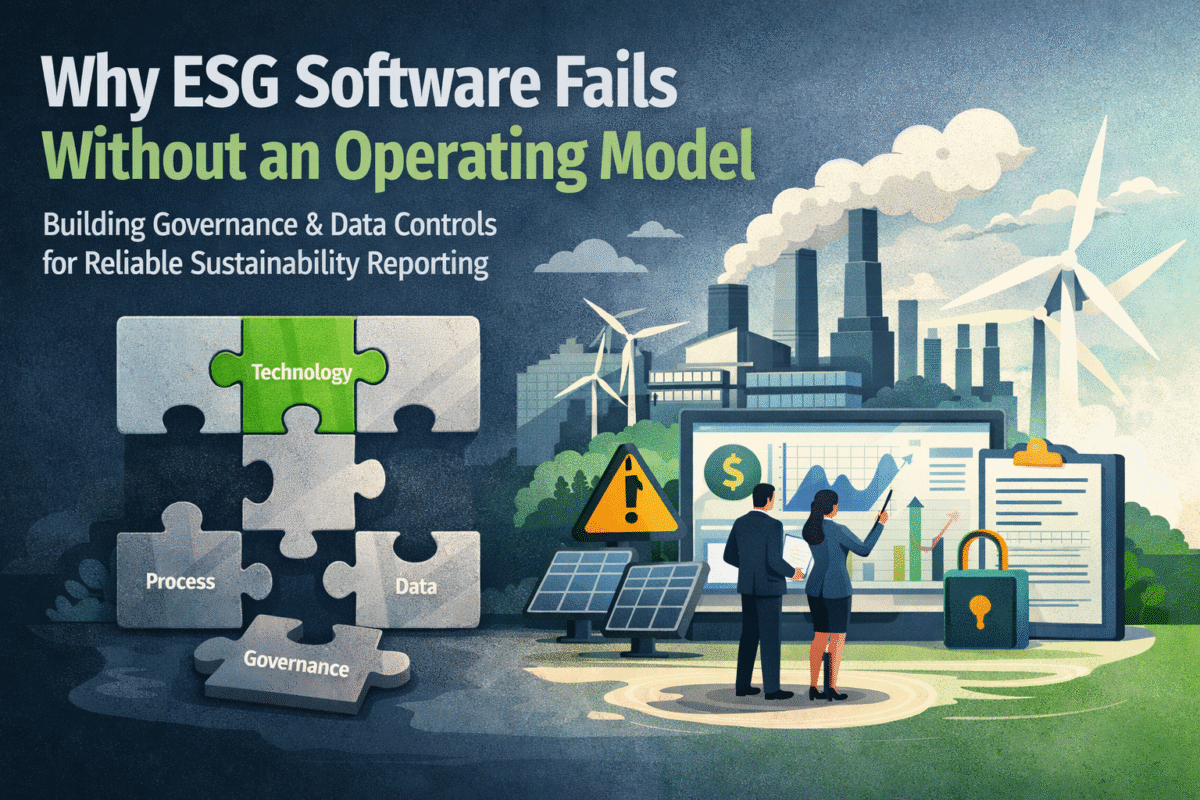
Control ownership is usually the weakest link in ESG reporting capabilities and environments. Many organisations do not lack data or the required tools. They lack clear accountability for control ownership and execution.
An appropriately designed ownership structure should incorporate:
- Design methodologies and reporting logic that are developed by sustainability teams/ personnel
- Uniquely named resources owning processes/ actions with primary and secondary (failover) responsible individuals
- Operations driven submission of site/ field level data, that is subject to appropriate data validation
- Finance review of interim KPIs/ outputs for plausibility
Unless the organisation is able to create a culture of unique ownership of process step/ data, control failures will occur due to the following reasons.
- Controls are assumed, not executed: Reviews happen informally, without defined criteria or documentation.
- Accountability is diluted: When errors are found, responsibility is shared—and therefore owned by no one.
- Evidence is inconsistent: Each function retains evidence differently, making retrieval unreliable.
An Effective ESG Control Ownership Model
Mature ESG control environments adopt role clarity that mirrors financial reporting. They form the basis of audit sufficiency which is a key determinant during external assessments. Key responsibilities that each role must typically assume are as below:
| Role | Responsibility |
| Data Owner | Generates source data from operations or systems |
| Control Owner | Executes specific controls designed to prevent or detect errors |
| Process Owner | End-to-end accountability for the ESG process and its risks |
| Reviewer | Independent challenge and review |
| Assurance Liaison | Coordinates evidence, testing, and auditor interaction |
The decision logic for assigning control ownership should sit at the intersection of:
- Where errors can be prevented or detected earliest;
- Where process knowledge exists;
- Where authority to enforce correction exists
It should follow risk origination, not organisational hierarchy. Assigning control ownership to reporting teams is a recurring design flaw which should be avoided at the outset.
Evidence Sufficiency: What Actually Supports ESG Data
Auditors and regulators do not rely on narratives. They rely on evidence. As such, many organisations assume that a documented methodology or explanatory narrative constitutes evidence. Under assurance, neither does. Below are the key determinants of what is acceptable ESG evidence.
- It comes from a reliable source
- It supports a specific assertion
- It is retrievable without re-creation
Common evidence types include:
- Source documents (utility invoices, supplier attestations, payroll records)
- System audit trails showing uploads, changes, approvals, and timing
- Calculation workpapers showing inputs, assumptions, logic, and outputs
- Review sign-offs with documented challenge
- Version-controlled methodologies with change history
Evidence that cannot be tied to a control and an assertion is not persuasive—regardless of how much effort went into producing it.
Evidence Failure Example
An organisation claims Scope 3 completeness but cannot demonstrate:
- How suppliers were selected
- How missing data was treated
- Why assumptions changed year over year
This is not a disclosure issue, it is a control failure.
Control Testing and Sampling
If ESG data is relied upon, controls cannot be assumed to work in isolation. They must be subjected to a verification and validation process to ensure they are functioning as desired.
Typical testing approaches vary by control type:
- Automated controls: tested through configuration review and access logic
- Manual controls: tested through sample inspection of execution
- Review controls: tested by evaluating whether challenge occurred, not merely approval
- Estimates: tested by assessing consistency and application of methodology
Sampling to pick the required data sets must be risk-based, not convenience-based. Factors include:
- Degree of subjectivity
- Volatility of the metric
- History of errors
- Geographic dispersion
- Number of contributing sources
Example:
Scope 3 Category 1 data warrants higher sampling intensity than Scope 1 fuel data due to estimation risk and external dependency. As such, sampling is not about efficiency. It is about coverage of risk.
Assurance Readiness Is a Control Outcome
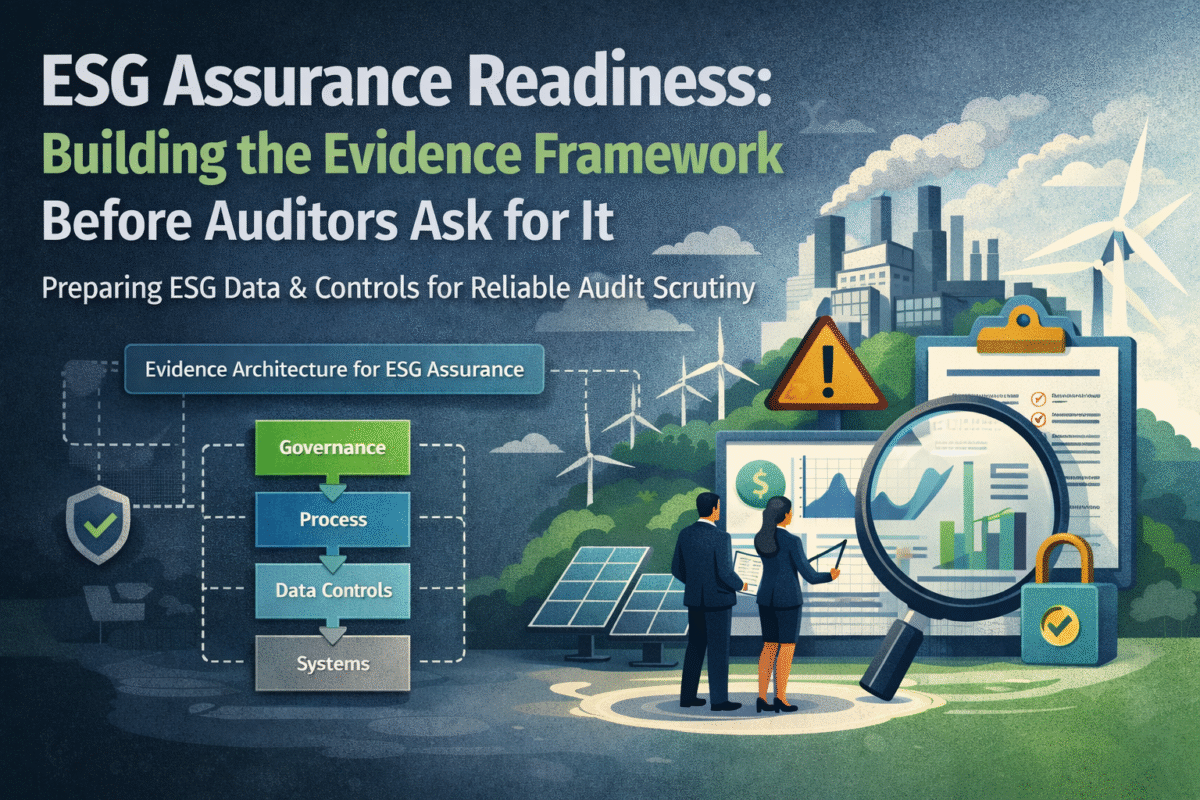
Assurance readiness is not achieved by improving disclosures, selecting the “right” framework, or producing more detailed narratives. It is the natural outcome of operating a controlled ESG reporting environment. An organisation is assurance-ready when its ESG risks are explicitly identified and treated as control risks, not reputational concerns. For each material risk, controls are deliberately designed to prevent or detect misstatement. Those controls are not implicit or informal; they are executed by named owners with clear accountability for performance.
To conclude an organisation is assurance ready when:
- Key ESG controls are identified and formalised across work streams and operational/ reporting levels
- Control owners are named, trained and motivated
- Evidence is retrievable and traceable across the value chain
- Controls are tested and can be evidenced
- Deficiencies, if any, are remediated and re-tested to satisfaction
Once achieved, assurance becomes an evaluation of system reliability, not a forensic exercise. Auditors are able to rely on processes rather than re-perform calculations, reflecting operational maturity and strong governance.
How CorpStage Supports ESG Internal Control Maturity
CorpStage supports organisations in operationalising ESG internal controls by combining structured advisory expertise with a purpose-built ESG management platform. From a consulting perspective, CorpStage works with sustainability, finance, and risk teams to translate SOX-aligned control logic into ESG-specific control designs, including risk identification, assertion mapping, control ownership models, and assurance-ready evidence requirements. This is complemented by the CorpStage ESG 360 platform, which embeds these controls directly into ESG data workflows—enforcing approved methodologies, maintaining version control, capturing audit trails, and enabling preventive and detective controls to function consistently across entities and reporting periods. Together, this integrated approach allows organisations to move beyond narrative-driven ESG reporting toward a controlled, systematised, and assurance-ready ESG operating environment that can withstand regulatory scrutiny and external assurance over time.