
ISSB S1 and S2 Implementation Guide: Moving from ESG Reporting to Financial Integration
ISSB S1 and S2 Implementation Guide: Moving from ESG Reporting to Financial Integration
ESG Financial Integration- Why ISSB Standards Are Reshaping ESG Reporting in Capital Markets
The introduction of ISSB IFRS S1 and IFRS S2 standards marks a decisive shift in how organisations approach sustainability reporting. These standards are not designed to increase reporting burden—they are intended to embed sustainability into financial decision-making, risk management, and capital allocation.
Backed by global regulators such as the International Organization of Securities Commissions, ISSB standards have elevated ESG disclosures from narrative reporting to investor-grade financial information.
Today, sustainability data is no longer peripheral—it directly influences valuation, cost of capital, and investor confidence.
The Core Problem: Why Most ISSB Implementations Fail
Despite widespread adoption efforts, most organisations are still misinterpreting ISSB S1 and S2.
Instead of treating them as enterprise-wide system requirements, companies often approach them as:
Disclosure checklists
Sustainability team outputs
Standalone reporting exercises
This leads to a fundamental breakdown:
ESG teams operate independently
Finance teams remain disconnected
Risk and strategy functions are not integrated
The result?High-quality reports with low credibility under investor or audit scrutiny.
ISSB S1 vs S2: What Actually Changes in Practice
Understanding the distinction between S1 and S2 is critical for effective implementation.
IFRS S1 – Enterprise-Wide Sustainability Integration
Covers all sustainability-related risks and opportunities
Establishes linkage between ESG and business value
Requires integration across governance, risk, and strategy
Focuses on enterprise-level data architecture
IFRS S2 – Climate-Specific Financial Impact
Focuses specifically on climate-related risks and opportunities
Requires scenario analysis, emissions data, and transition plans
Emphasises financial materiality of climate risks
Has higher assurance expectations (modelling, assumptions, estimates)
Where Companies Go Wrong
Most organisations:
Over-invest in climate modelling (S2)
Under-invest in governance and systems (S1)
This creates a dangerous imbalance:
Advanced climate scenarios without credible data governance or controls.
The Financial Integration Gap: Where ESG Systems Break Down
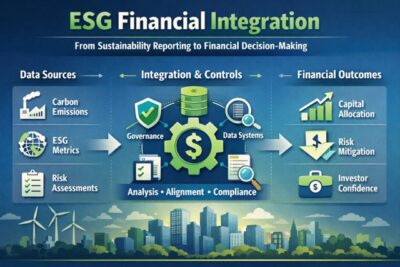
The biggest failure point in ISSB implementation is financial integration.
Evidence from the European Central Bank revealed that many institutions could not:
Link climate risks to balance sheets
Integrate ESG assumptions into financial planning
Translate sustainability risks into cash flow impacts
This pattern is now visible across industries:
Climate risks identified, but not reflected in budgets
Scenario analysis conducted, but not used in decision-making
Emissions data collected, but not linked to capital allocation
A well-known example is Shell plc, where investor scrutiny highlighted the gap between net-zero commitments and capital expenditure decisions.
This is precisely the gap ISSB aims to close:
From disclosure → to decision-making
Governance: The Foundation of ISSB Compliance
ISSB implementation is not a data problem—it is a governance problem first.
The Financial Reporting Council has repeatedly identified weak governance as the primary reason ESG disclosures fail under scrutiny.
Common Governance Failures
ESG committees operating in isolation
Lack of ownership between finance and sustainability teams
Absence of documented controls and accountability
Weak board-level oversight
What Good Governance Looks Like
Leading organisations such as Unilever demonstrate:
Board-level ESG integration
Alignment between sustainability strategy and financial decisions
Clear accountability across functions
ISSB success requires integration across board, audit, risk, and executive functions.
ESG Data Architecture: The Hidden Constraint
A major barrier to ISSB implementation lies in weak ESG data systems.
The European Securities and Markets Authority has flagged inconsistent ESG disclosures due to:
Poor data traceability
Lack of system integration
Weak control environments
The ISSB-Aligned Data Architecture Model
To achieve assurance-ready ESG reporting, organisations must build a three-layer architecture:
1. Source Layer (Data Capture)
ERP, HRMS, energy systems
Supplier data (Scope 3 emissions)
Climate models and external inputs
2. Control Layer (Validation & Governance)
Calculation methodologies
Approval workflows
Version control and audit trails
3. Disclosure Layer (Reporting Output)
Direct mapping to ISSB S1 & S2
Read-only outputs
Prevention of last-minute manipulation
Companies that calculate ESG metrics only at the reporting stage will fail assurance due to lack of data lineage and control traceability.
Internal Controls: Applying Financial Discipline to ESG
ISSB introduces a fundamental expectation:ESG data must be governed with the same rigour as financial data.
This aligns closely with principles under the Sarbanes-Oxley Act.
Key Control Types for ESG Systems
Preventive Controls
System validations
Mandatory fields
Locked methodologies
Detective Controls
Variance analysis
Reconciliations
Trend monitoring
Governance Controls
Maker-checker workflows
Role-based approvals
Evidence documentation
The reality:Most organisations define controls but fail to operationalise them.
Assurance Readiness: Designing ESG Systems for Audit
ISSB assumes that ESG disclosures will be subject to assurance.
This means organisations must be able to demonstrate:
Data lineage from source to disclosure
Consistency in methodologies
Evidence of control execution
Companies like Volkswagen Group have strengthened their ESG systems to meet assurance expectations.
Critical insight:
Assurance failures rarely arise from incorrect numbers—they arise from weak systems, processes, and governance.
How to Implement ISSB S1 & S2: A Practical Framework
A structured implementation approach typically involves five phases:
Phase 1: ESG Diagnostic & Gap Assessment
Identify gaps across governance, data, and controls
Map current state vs ISSB requirements
Phase 2: Define Boundaries & Methodologies
Standardise calculation methods
Establish organisational boundaries
Phase 3: Build ESG Data Architecture
Integrate systems across departments
Implement control frameworks
Phase 4: Achieve Assurance Readiness
Document processes
Conduct internal testing and mock audits
Phase 5: Continuous Improvement
Refine methodologies
Improve data quality and system maturity
Why ISSB Matters: The Capital Markets Perspective
ISSB is fundamentally about capital markets trust.
Investors increasingly rely on ESG data to assess:
Transition risks
Long-term cash flows
Strategic resilience
Organisations that fail to implement ISSB effectively face:
Reduced investor confidence
Higher cost of capital
Increased scrutiny from regulators
Conclusion: From ESG Reporting to ESG Credibility
ISSB S1 and S2 are not just reporting standards—they represent a new operating model for ESG.
They require organisations to move:
From narrative → to measurable data
From sustainability → to financial integration
From compliance → to strategic decision-making
Ultimately, companies that succeed will be those that:✔ Integrate ESG into financial systems✔ Build governance-led ESG architectures✔ Deliver assurance-ready disclosures
This is where ESG transitions from a reporting exercise to a driver of enterprise value and capital allocation discipline.