
Building a Transformative ESG Governance Framework for Sustainable Growth

Building a Transformative ESG Governance Framework for Sustainable Growth
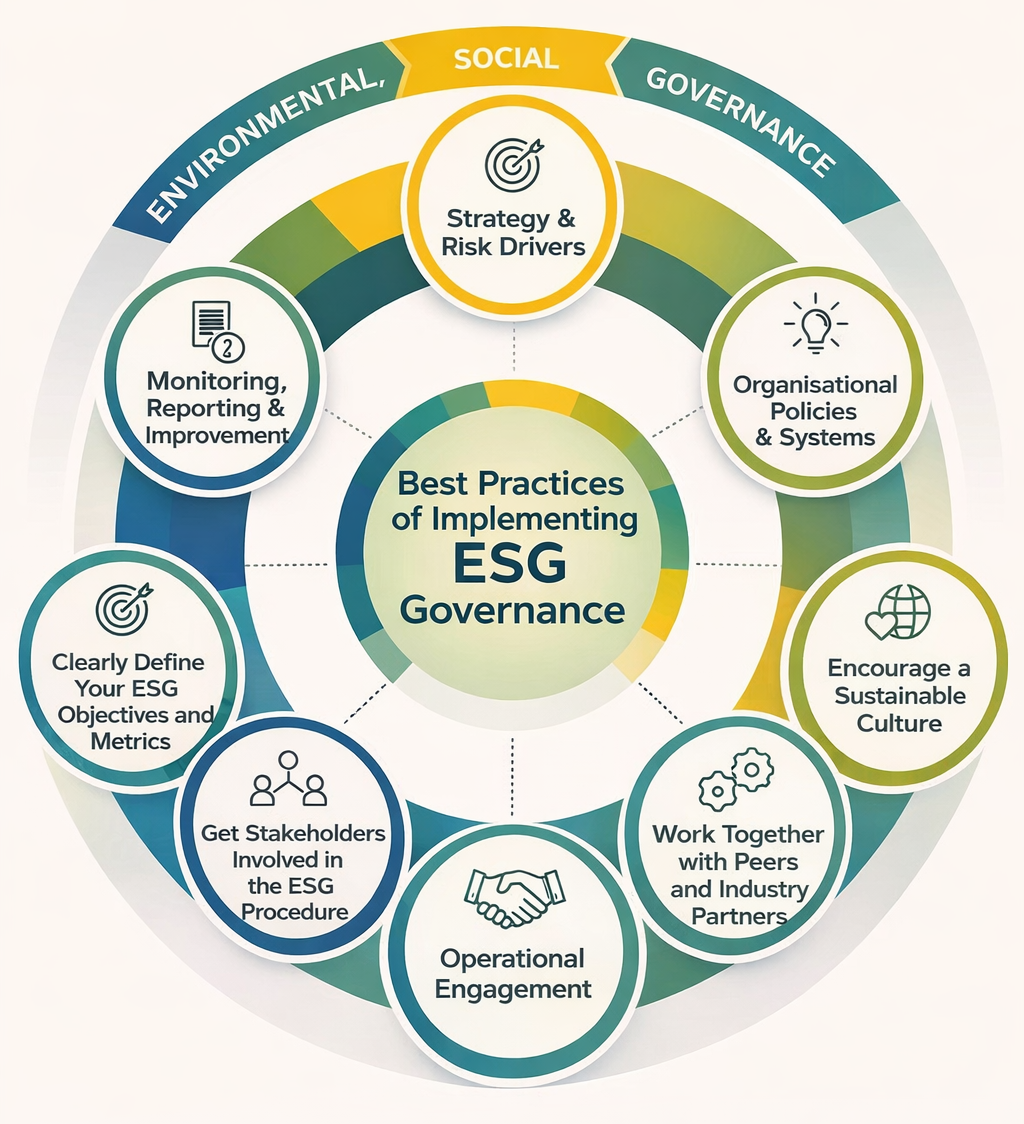
Over the past few years, ESG has transcended from being a major corporate responsibility department issue to becoming the heart of boardroom discussions and agendas. ESG considerations such as workforce diversity, supply chain emissions, and renewable energy utilisation are no longer satellite issues for businesses; instead, they are financially material issues that are important for corporate governance.
It is expected that management, regulators, and investors will focus significant resources on demonstrating appropriate ESG over such risks. The International Sustainability Standards Board (ISSB) has stipulated that organisations provide disclosure on how governance is being exercised in reviewing sustainability-driven risk and opportunities. In fact, even the European Sustainability Reporting Standards [ESRS] require organisations to demonstrate a management role in supervising sustainability-related issues
Despite the rise of search regulatory requirements and board-level scrutiny, many businesses find it difficult to put into play ESG governance at their boards. While sustainability topics are part of the management agenda required governance framework to drive these often remains abstract, roles are poorly defined, committees operate in silos, and escalation processes are sometimes unclear. This results in a governance gap, which manifests itself in a high level framework for ESG being defined, but little being done to implement it well.
It is important to not just articulate the ESG strategy but also institutionalise robust governance frameworks that must evolve over time to appropriately provide oversight of sustainability risks in the same spirit and discipline as that of financial management.
Board versus management roles
Corporate governance frameworks are underpinned by a clear differentiation between oversight and actual implementation. Wildest boards are expected to provide oversight and strategic pointers; it is expected that the corporate management will put in place the mechanisms to operationalise the ESG board level activities.
As such, the government structures that are put in place should follow the same principle and clearly call out the difference between simple oversight and execution. The role of the board of directors is that of providing the high-level ESG strategy, management of risks, and clear oversight of the ESG performance- this leads to strong ESG Governance.
The typical responsibilities cover the following:
- Setting out the organization’s sustainability strategy and goals
- Providing oversight of key plans such as climate transition, energy efficiency
- Providing management oversight of the underlying ESG risk management frameworks
- Reviewing and driving internal controls to ensure accurate sustainability reporting
- Regularly reviewing and monitoring overall ESG progress.
These disclosure standards typically require organisations to demonstrate that the board oversees sustainability-related opportunities and risks through appropriate board-level conversations, forming committees, and management decisions that are taken in this regard. It is therefore evident that boards do not directly manage the sustainability initiatives, but rather institutionalize the governance frameworks and risk management processes to do so.
Management responsibilities
On the other hand, managements are expected to translate the board-level directives into operational programs and projects. Typical examples of management responsibilities cover the following:
- Project and implementation charters of sustainability programs
- Putting in place other data collection and reporting processes and systems
- Centralising ESG considerations through integration of processes, systems, and people
- Defining ESG risk registers and deploying appropriate escalation routes
Due to the inherent nature of ESG risk at the intersection of multiple operational domains, it is incumbent on the management to closely coordinate between functions to ensure that the ESG performance is not limited to stand alone initiatives.
A typical corporate example is that of Microsoft’s governance structure: Microsoft has a well-developed board-level ESG framework. The organisation’s Environmental, Social and Public Policy Committee functions within the board and provides direct oversight of sustainability and social impact initiatives. This committee focuses on how the executive leadership is implementing the operational projects under the guidance of the board’s ESG strategies.
As such, this committee clearly delineates execution from top-level strategy making to ensure that the sustainability issues receive appropriate board-level focus and are also followed up with suitable management-level programs.
Committee structures
It is a common phenomenon for companies to incrementally add new board-level committees as their ESG issues expand. While it seems like an easy approach to increase focus on sustainability-related issues, it also creates governance risks. Whilst having multiple committees helps address ESG issues, such as review of sustainability reporting, risk committee oversight of climate issues, compensation committees reviewing executive pay, without appropriate coordination, these responsibilities can create redundancies and add to executive-level confusion. It is therefore necessary to have appropriate governance models to drive ESI oversight. There are certain common committee structures that are evolving in the light of ESG:
- Dedicated sustainability committee: Some managements have been found to set-up a dedicated ESG or sustainability committee, which is directly responsible for providing oversight of ESG strategy performance and disclosure.
- Distributed committee model: This is another approach where some organisations distribute the ESG oversight responsibility across existing committees. This might include an audit committee overseeing ESG disclosure, a risk committee monitoring climate risk, and a separate compensation committee for the executive review. The advantage here is that there is good integration across existing governance processes, but the implementation complexity often rises.
- Hybrid model: this is a combination of both the above approaches and results in a combination where a sustainability committee is in charge of strategy and is additionally supported by other committees, which oversee specific aspects related to ESG data collection, risk management, and reporting
A good example from the industry is that of Unilever. Unilever has managed to create a hybrid model of governance where sustainability strategy is held at the board level and has specific responsibility offshoots such as risk and reporting sitting under governance committees. As such, this approach creates a long-term integration of sustainability into Unilever’s corporate strategy.
Escalation thresholds
It is not possible for boards to provide oversight of every operational detail of ESG. That is why it is important to put in place robust escalation mechanisms that determine how management provides oversight to ESG performance and which issues need to be escalated right to the board. If there are no thresholds, then the boards end up receiving information that is both very granular and of low strategic importance, and sometimes too late for decisions to be taken. Therefore, escalation frameworks are created so that material risks can reach the board bottom up in time for meaningful oversight and action.
Typical escalation triggers comprise the following:
- Regulatory exposure: ESG issues that relate to non-compliance with regulations are of strategic importance and should be immediately flat to the board.
- Financial impact: incidents such as supply chain disruptions or environmental risks have material financial significance and require the board to be sensitised in a timely manner
- Strategic risks: resettle evolving and unlikely to affect the long term strategy, such as carbon pricing or net zero performance, should also be reported to the board in a timely manner
- Reputational events: Happenings or controversies in the social domain, for example, might cause reputational damage and require immediate action on the part of the board
Over the past few years, many multinational organizations have had to face investor scrutiny after labour violations were found in their supply chains. Therefore, it is important that appropriate escalation frameworks are embedded into an organization’s operational processes, such as material risks, such as supply chain risks, are escalated to the board in a timely and predetermined manner.
Information flows
In modern times, boards are flooded with a large volume of earth information comprising various reports, dashboards, and performance information. In fact, research in corporate governance affairs demonstrates that currently boards are often found to struggle with oversight of years of ESG risks because information is often voluminous, fragmented, and appears from diverse reporting channels. Having an effective governance framework requires information to flow through in predetermined and structured workflows. Designing ESG reports for boards encompasses objective decision-relevant information flowing up:
- Progress that is made against ESG targets should flow in an objective and time-bound manner.
- Evolving regulatory risks, such as supply chain risks and operational hazards has to be flagged in real time.
- ESG performance trends as they evolve over time also need to be shown to the board in a time-sensitive manner
It is important for boards to be able to rely on the underlying ESG information. As such, regulators are expecting companies to implement appropriate internal checks and balances which ensure that the sustainability reporting capabilities are quality checked and robust in that the underlying data points are system-generated and verified. The boards have to eventually rely on tested control data systems and not stand-alone spreadsheets and manual data feeds.
Oversight cadence
It is important that regular oversight of ESG issues is exercised to review formal and informal ESG issues at the board level. Discussing them at predetermined intervals of time shows that the board does not miss any emerging ESG risks. On the other hand, discussing them too often results in unstructured, meaningless conversations that do not bring about the desired focus on edge. As such, effective governance mandates a structured yes she kittens that incorporates the following:
- Strategic annual reviews: these typically prioritise long-term targets and are often reviewed annually at the board level
- Quarterly reviews: these are one level lower and focus on the real-time ESG performance matrix and transition plans, which are often found to be aligned with financial reporting cycles
- Advisor reviews the major red flags or ESG incidents, which require immediate board discussions and might be conducted as and when required.
Regulators and institutional investors are expecting boards to deploy active oversight structures through regular caddons and documented feedback mechanisms. This helps to materially qualify and quantify ESG as they occur from time to time. In the industry, large asset managers have been found to emphasise that their boards regularly conduct such reviews, and they form part of investment committee inputs at the time of making last scale investments.
Investors are increasingly considering chakrapani trying to find a direct correlation between strong governance oversight on sustainability issues and favourable investment outcomes. In addition, boards are also viewing ESG as a natural extension of the enterprise risk management framework and not simply corporate social responsibility. This is signalling a strategic thinking that is underpinning robust ESG performance in areas such as supply chain vulnerabilities, climate transition risks, and even regulatory changes.
In conclusion, the true difference between an overload of sustainability governance structures and organisations that do not meaningfully conduct sustainability reviews lies in the essence of design discipline. An effectively designed ESG framework clearly separates board oversight and management execution, resulting in robust ESG outcomes.
For more details or requesting for RFP- Please Contact Us.
Download the pdf —Designing a board-level ESG governance framework that actually works